The WHO distinguishes 4 types of FGM/C (latest version 2008 of the UN Interagency Statement “Eliminating FGM”):
Type I Clitoridectomy: Partial or total removal of the clitoris and/or the clitoral hood
a Removal of the clitoral hood
b Removal of the clitoris and the clitoral hood
Type II Excision: Partial or total removal of the clitoris and the labia minora, with or without removal of the labia majora
a Removal of the labia minora
b Partial or total removal of the external clitoris and labia minora
c Partial or total removal of the external clitoris as well as the labia minora and majora
Type III Pharaonic mutilation or infibulation: Narrowing of the vaginal opening with the creation of a covering, scarred skin seal after removal of the labia minora and/or majora by stitching or sewing the wound edges together, usually with removal of the clitoris.
a Removal and stitching together of the labia minora, with or without removal of the clitoris
b Removal and stitching together of the labia majora, with or without removal of the clitoris
Type IV All other harmful procedures that injure the female genitalia and serve no medical purpose, for example: pricking, piercing, incising, scraping, cauterizing, or stretching.
*Infibulation (Latin: fibula = clasp) involves the removal of the entire labia majora and minora and the clitoris. The outer wound edges are then joined together with thorns or other local materials, so that after healing, a smooth, scarred skin plate closes the vagina except for a tiny opening (usually at the back).
- 80% Type I and II are the most widespread globally.
15% of surviving women and girls live with Type III.
5% of those affected are impacted by Type IV.
This classification is only a rough approximation of the many local variations. Especially in rural areas, the procedure is performed according to the prevailing ancestral tradition.
FGM/C in Germany and Hamburg
In Germany, an estimated 123,000 women and girls were affected by FGM/C or considered at risk by the end of 2024; of these, approximately 86,500 adult women have already undergone some form of genital mutilation, while around 11,100 minor girls are considered potentially affected and up to 25,000 more girls are classified as at risk. The current estimate was prepared by Prognos AG on behalf of the Federal Ministry for Education, Family, Senior Citizens, Women and Youth, based on the foreign statistics of the Federal Statistical Office for 31 countries of origin, and shows an 83 percent increase in affected adult women compared to the last comparable estimate in 2017.
In 2011, 11,200 people of African descent lived in Hamburg. 39% of them come from families where the practice of genital mutilation is still carried out. 30% of women from practicing countries are circumcised. 80% support abandoning female circumcision. 70% of them believe that FGM offers benefits and 20% want to continue the procedure (Plan International e.V. 2011, p.7).
Brief History of FGM/C
Oral traditions and linguistic studies indicate that female genital mutilation was practiced in Egypt as early as three thousand years before Christ, long before the various monotheistic religions.
FGM/C: A Global Phenomenon
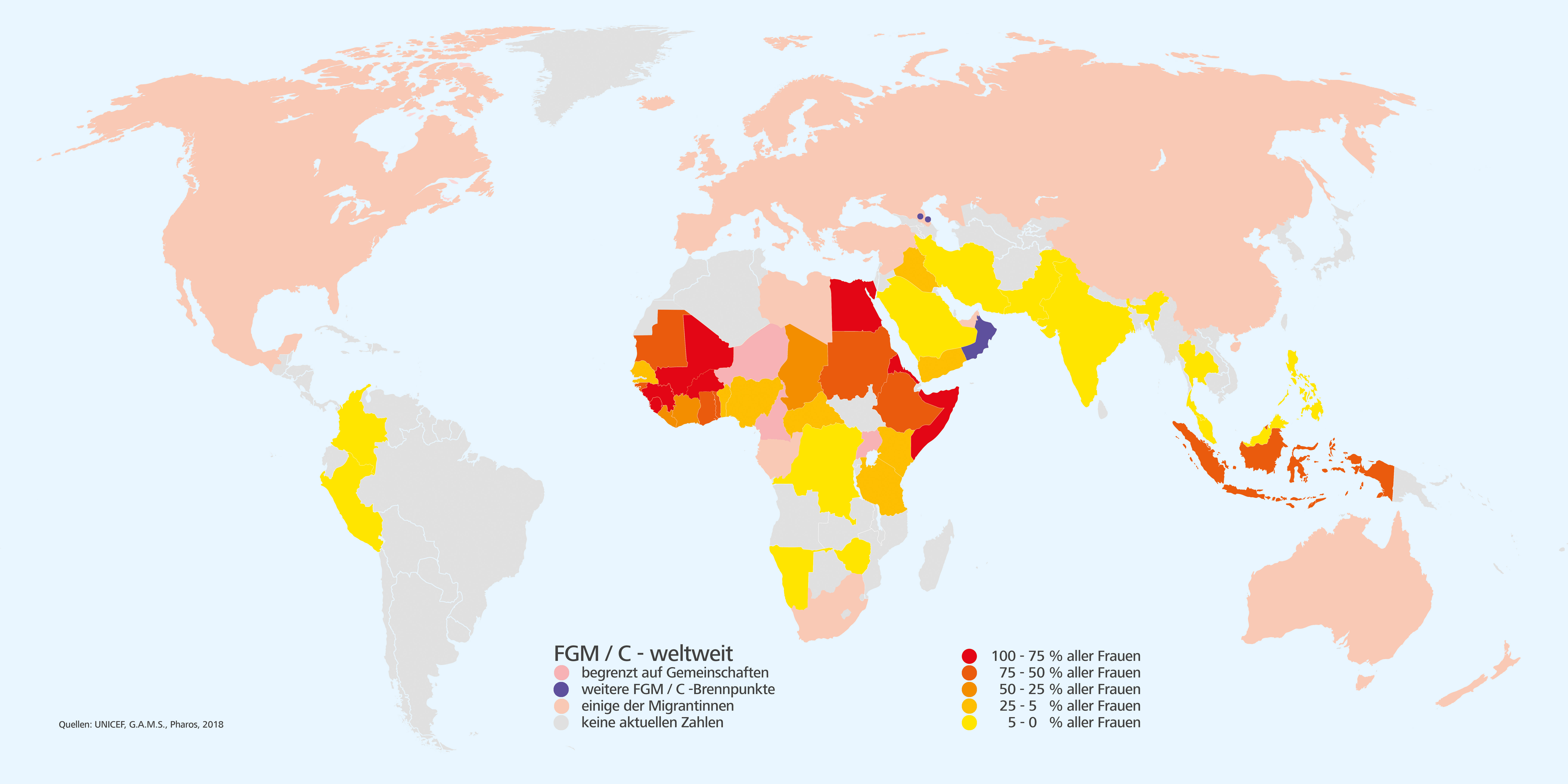
Female genital mutilation is a phenomenon practiced worldwide, in parts of Africa (in regions of the Sahara and the Sahel), the Near and Middle East (Yemen, Oman, the Kurdish part of Syria, Iraq and Iran), but also in parts of Russia, Dagestan, parts of India, Indonesia, Malaysia, Thailand, among certain population groups in Australia, New Zealand, parts of Western Brazil, Mexico, Colombia, and Peru. FGM is not an isolated African phenomenon, as is falsely claimed, but a global problem.
FGM/C Worldwide
Globally, according to UNICEF estimates from 2024, over 230 million women and girls are affected by FGM/C, an increase of 15% since 2020 due to new data and population growth. Another 4 million women and girls are at risk each year. FGM/C has been practiced for millennia and is documented as a practice in over 94 countries, in Africa (approx. 144 million), Asia (80 million), and the Middle East (6 million), with 3–4 million new cases annually. The highest prevalence rates (80–99%) are found in countries such as Somalia, Guinea, Djibouti, Mali, Egypt, Sudan, and Eritrea.
FGM/C in Europe
Due to increasing South-North migration, female genital mutilation is now also prevalent in many European countries. Today, more than 600,000 survivors of female genital mutilation from different parts of the world live in European countries. Most affected women live in large cities.
FGM/C causes severe pain and traumatic experiences with immediate and long-term physical and psychological risks.
Acute Risks
-
Severe, sometimes life-threatening bleeding.
-
Acute, intense pain during and after the procedure.
-
Hemorrhagic, neurogenic, or septic shock.
-
Inflammatory reactions or local infections with swelling.
-
Local infections, abscesses, sepsis, genital, birth canal, and urinary tract infections.
-
Increased HIV risk, especially when using non-sterile cutting tools.
-
Acute urinary retention, pain during urination, prolonged bladder emptying.
-
Delayed or impaired wound healing.
-
Death due to exsanguination or severe infections (sepsis).
Risks during Pregnancy and Childbirth
-
Prolonged labor, difficult, protracted childbirth.
-
Increased risk of C-section, forceps delivery, or episiotomy.
-
Birth injuries: Perineal tears, additional wound formation.
-
Increased risk of stillbirth or neonatal death during and after birth.
-
More frequent resuscitation measures for the newborn
-
Blood loss of 500 ml or more (postpartum hemorrhage) after birth
-
Prolonged hospital stay for mother and/or child.
Sexual Dysfunction
-
Significantly increased risk of pain during sexual intercourse, especially with more severe forms (e.g., Type III).
-
Reduced libido, diminished sexual stimulation.
-
Difficult penetration due to reduced lubrication, increased pain, and risk of injury.
-
Absent or infrequent orgasm, restriction of sexual self-determination
-
Psychosocial consequences due to anxiety, pain, relationship conflicts, lower self-esteem.
Psychological Risks
-
Post-traumatic stress disorder (PTSD): Anxiety disorders, depression, aggression, irritability.
-
Emotional distress: Identity conflicts, alienation from one’s own body, shame and guilt.
Long-term Risks
-
Chronic pain, especially in the genital and pelvic areas.
-
Vaginal discharge, often infection-related, sometimes chronic.
-
Recurrent vaginal itching, often due to infections or scar changes.
-
Menstrual problems: Severe menstrual pain, irregular bleeding, delayed blood flow.
-
Recurrent bacterial infections of the vulva and vagina.
-
Risk of pelvic infections (e.g., pelvic inflammatory disease).
-
Frequent recurrent inflammations of the urethra.
-
Pain and burning during urination, often due to narrowing or infections.
– in progress –
We advise affected families, affected girls, influential members, organizers from affected communities, as well as refugees, pastors or imams, or multipliers.
- We raise awareness in different communities. We provide a space for exchange and support women in overcoming the psychological consequences of female genital mutilation.
- We are currently creating and strengthening networks of women and striving to empower them internally and emotionally, making them more self-confident. We encourage them to speak about it without frustrating their husbands.
Young activists are trained to raise awareness among younger generations against FGM/C
- Women active against FGM/C consists of women from diverse backgrounds and meets monthly, alternating at members’ homes. By supporting each other in coping with everyday problems, they strengthen their community. Together, they then advocate for better education and women’s participation in society. This space benefits victims of genital mutilation by allowing them to open up. Multipliers who have been trained to act against FGM/C are active in Women active against FGM/C. This women’s group receives pedagogical support.
- We support the social engagement and societal participation of those affected.
If you are interested, you can reach us every Wednesday from 9:00 AM – 1:00 PM.
Contact Person
Gwladys Awo
Tel.: +49 176 30184468
Gwladys Awo
Tel.: +49 176 30184468
We offer training courses against female genital mutilation for institutions and NGOs nationwide. Would you like to learn more about transcultural approaches, counseling, or asylum issues concerning female genital mutilation? Then contact us.
info@lessan.eu


